
Huntington Park Wood Flooring is called for wood flooring in Watts more often for water than for anything else. A supply line lets go, a water heater fails, a roof leaks through a winter, and by the time anyone looks properly the damage has spread well past the stain that first drew attention. The single most useful thing to understand about a wet floor is that nothing can be decided while it is wet. Wood swells as it takes on moisture and shrinks as it gives it back, so a floor assessed too early gets assessed wrongly in both directions at once.
Boards that look ruined frequently recover completely. Damage that looks trivial sometimes turns out to have reached the joists. This page is about establishing which is which, in the right order, before anybody commits money to a repair.
Finding Out How Far the Water Went
Water Follows the Structure
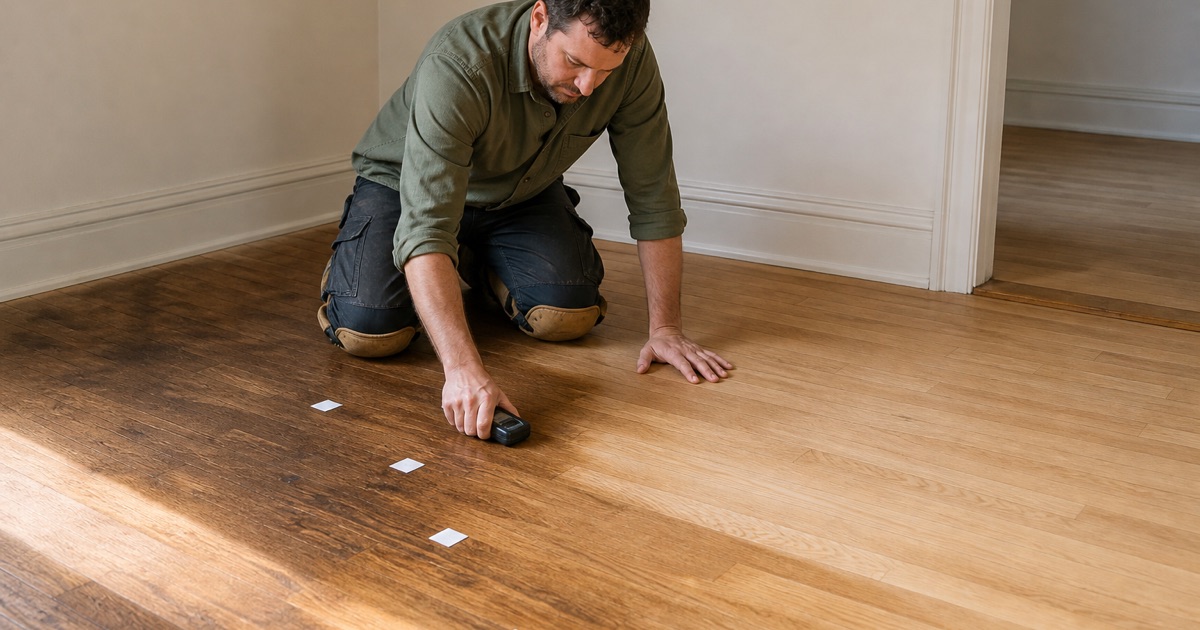
Water does not spread in a neat circle from wherever it arrived. It runs along the underside of boards, follows joists, tracks through wall plates and finds whatever fall the structure happens to have. The wet area is almost always larger than the discoloration that made somebody call.
That is why we map rather than eyeball. Moisture meters are run across the floor and into the adjoining rooms until readings return to normal, and the boundary that produces is the real extent of the problem. Watts is a neighborhood within the City of Los Angeles rather than a separate municipality, and much of its housing is the single-story raised construction common across this part of the county. On a raised floor water reaches the crawl space quickly and then spreads underneath, which is exactly the case where the visible stain understates things most.
Finding the Source First
Nothing is worth repairing while water is still arriving. Sometimes the source is obvious and sometimes it is several rooms away, and a recurring damp patch with no plumbing above it is frequently arriving from the crawl space or from outside the building entirely. We establish and confirm the source before quoting a repair. Where that falls outside our trade, which it often does, we say so plainly rather than working around it and letting somebody else discover the problem later.
An owner who fixes the floor without fixing the cause has bought the same repair twice. It is the most common expensive mistake in this kind of work, and it is entirely a sequencing problem rather than a technical one.
Looking Underneath
Water that reached the finish floor has generally reached the subfloor, and sometimes the joists below that. Where there is crawl space access we go in and look, checking for staining, elevated moisture readings, delamination and any sign of rot in the structure. That inspection changes scopes regularly. A floor that looked like a board-replacement job turns into a subfloor job, or a subfloor that looked compromised turns out to be sound and the repair gets smaller.
Either way it is better known now. Repairing a finish floor over a wet subfloor seals moisture into the assembly where it continues working, and the failure that follows is both slower and more expensive than the original problem. Looking for wood flooring closer to Boyle Heights? See Wood Flooring Services in Boyle Heights.
Drying Before Any Decision
Measured Rather Than Judged
Drying is monitored with meters and the readings are recorded over time, because a floor can feel completely dry on its surface while the subfloor beneath it sits well above any acceptable range. Touch tells you almost nothing useful here. The floor is not touched until those numbers reach target for the species and the assembly. That is not caution for its own sake; every operation after this point depends on the wood being at a stable moisture content.
Where a restoration company has already handled emergency drying, we ask for their readings rather than assuming a structure signed off as dry to a general standard is dry enough for hardwood. Those are different thresholds and the difference matters.
Cupping That Recovers
Boards that took water from underneath swell on their lower face and lift at the edges, which is what cupping is. A large proportion of it flattens out on its own as the floor releases that moisture evenly, and floors that look destroyed in week one are frequently close to flat by week four. That is why patience genuinely saves money here. Condemning a cupped floor early is how owners end up paying for a replacement they did not need, and it happens routinely because a badly cupped floor looks alarming.
Where cupping persists after the structure has properly dried, or boards have crowned, split or delaminated, replacement is the honest answer for those boards. By then it is a decision made on evidence rather than on appearance.
Why Sanding Wet Wood Fails
Sanding a cupped floor flat while it is still carrying moisture takes off the raised edges. As the boards then dry and shrink, what was made flat becomes concave, and the floor ends up worse than it started with less wood left to fix it. This is the single most expensive avoidable error on a water job. It is not a matter of skill or equipment; it is purely a question of doing things in the wrong order, and it cannot be undone afterwards.
Any contractor offering to sand a floor that has not been dried and measured is offering to make the problem permanent. We would rather lose the work than take it on those terms.
Putting It Back
Replacing Only What Did Not Recover
Once the structure is dry and stable, the boards that genuinely need replacing are usually far fewer than the boards that looked ruined at the start. Those come out and are replaced with material matched in species, width, thickness and cut. New boards are woven into the existing field at staggered lengths rather than dropped in as a rectangular patch, so no continuous seam exists for the eye to follow. On older housing that generally means sourcing reclaimed stock or having material milled to the original profile.
The rest of the floor keeps whatever life it had. That is the whole point of waiting: the repair is scoped against the floor as it actually is, not against the floor at its worst moment.
Subfloor and Structure
Delaminated plywood, deteriorated board subfloor and joists that have lost section to rot all get dealt with before finish flooring goes back down. A softened joist is usually sistered rather than removed, with a new member fixed alongside it along its full bearing. Ground cover and ventilation in the crawl space are addressed at the same time where they are part of the problem. On a raised floor those are frequently why the water sat as long as it did rather than draining and drying.
All of this is dramatically cheaper while the floor is open. Closing it up and dealing with the structure later means lifting a finished floor to reach work that was accessible a fortnight earlier.
Refinishing and Records
The repaired area is sanded flush with the surrounding floor and blended into the existing finish, or the room is refinished where the surrounding finish has aged past the point anything can be matched into it. Where the work stops is planned at a room boundary rather than left to run out. Photographs, the moisture readings taken over time and a written scope of what was damaged and what was done are handed over at the end. Where a claim or a tenancy is involved that record is frequently the most valuable part of the job.
What we do not do is advise on insurance coverage or entitlement. That is a matter between a policyholder and their carrier, and we stay on the side of it we actually know something about.
How Long a Water Job Actually Takes
The Stage That Cannot Be Rushed
Drying sets the timeline and nothing else does. How long it takes depends on how much water arrived, how long it sat before anyone noticed, and how the building is constructed, and it is measured rather than estimated from experience. A floor on a raised foundation with good crawl space access dries differently from one over a slab, and a leak found in a week dries differently from one that ran all winter. We give a realistic range at the start and update it against actual readings.
What we will not do is commit to a completion date that depends on the structure drying faster than it is going to. That date would be wrong, and everything scheduled behind it would be wrong with it.
Working Around an Occupied House
Most of this work happens in houses somebody is living in, and drying equipment is noisy and takes up space. Where the affected area can be closed off, the rest of the house stays usable throughout, which is normally the arrangement. Repairs and refinishing are then phased so the household keeps part of the house at every stage. It takes longer overall than emptying the place, and for most people it is the difference between the work being possible and not.
We agree that sequence before starting rather than improvising it. A household that knows which rooms are out of use in which week can plan around it; one that finds out each morning cannot.
Where the Cost Actually Sits
The expensive parts of a water job are rarely the ones people expect. Drying, structural repair below the floor and sourcing matching boards for an older floor typically outweigh the sanding and finishing that most owners are picturing. That is worth knowing before deciding whether to proceed, because it changes the comparison against replacement. A floor with extensive subfloor damage may cost more to save than to replace, and a floor with none may cost far less.
We price both routes wherever both are genuinely available. An owner dealing with an unexpected loss deserves to see the real comparison rather than being steered toward whichever job is more convenient.
- Licensed & Insured
- Free Estimates
- 20+ Years Experience








