
Huntington Park Wood Flooring provides wood flooring in Walnut Park starting from a question we ask before any other: how much wood is actually left on the floor. On a great many floors here the answer is narrower than the owner expects, and it governs every decision that follows it.
The reason is arithmetic rather than pessimism. A floor laid in the 1920s and sanded two or three times since has already spent most of what it had, because the usable material is only ever what sits above the tongue. A floor can look entirely serviceable underfoot and still have nothing left to give a drum sander.
So we measure first and quote second. That order occasionally produces an unwelcome answer, and it remains far cheaper than the alternative, which is finding out halfway through a sand that the floor could not afford the cut it was being given.
Why the Oldest Floors Here Have the Least Left
The Age of the Housing
Around 70.3% of the housing units here predate 1950 and 82.0% predate 1960, which is the oldest profile anywhere in the area we cover. Walnut Park is a census-designated place in Los Angeles County rather than an incorporated city, and its housing went up early and then largely stayed put. The practical effect is that original floors are the norm rather than the exception. It also means those floors have had eighty or ninety years in which somebody might have sanded them, and a house that has passed through three owners has usually been through at least two refinishing decisions.
What a Sanding Actually Spends
Every full sand removes wood permanently, and there is no way to put it back. A refinish that takes a floor to bare timber costs a measurable share of everything above the tongue. Strip flooring from this period was milled thinner than modern stock to begin with, so the budget it started life with was already smaller than a new floor’s.
The consequence is that a floor here may have one sanding remaining where a modern floor would have four. Establishing which of those you own is not a technicality. It is the difference between a refinish and a full replacement, and between a few thousand dollars and considerably more.
Reading the History Before Touching It
Fastener heads sitting close to the surface, a pronounced lip where the floor meets a threshold, and boards gone thin around the perimeter all record work that has already happened. So does a floor sitting noticeably low against its own baseboard. None of that is visible from a clean, polished surface at a casual glance.
We read those signs before recommending anything at all, because they record what has already been spent from the floor’s account. A floor with an unblemished finish can easily have had more taken off it than a scratched one that nobody has ever touched. Looking for wood flooring closer to Florence-Graham? See Wood Flooring Services in Florence-Graham.
Measuring What Is Above the Tongue
Where the Measurement Is Taken
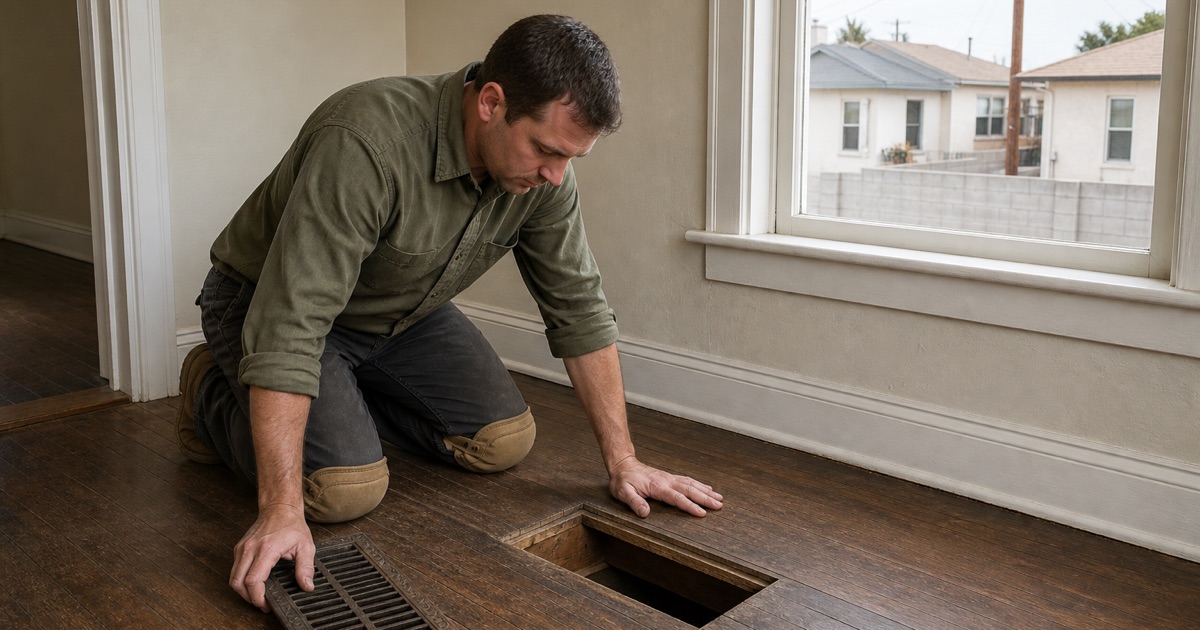
The reliable places are wherever a cut edge is already exposed: a doorway threshold, a floor register, the edge at the top of a stair, or the point where the floor stops at a hearth. We measure there rather than estimating from above, because the surface of a board tells you nothing whatever about the distance down to its tongue. Where no cut edge is accessible anywhere in the house, a single board is lifted in an inconspicuous spot and put back. It is a minor intrusion, it takes a few minutes, and it produces a real number, which is worth a great deal more than an experienced guess offered from a doorway.
Putting the Number in Writing
The measurement goes into the written scope alongside the species, the board width and the nominal thickness. That matters because it makes the recommendation checkable by somebody else. An owner being told their floor cannot be sanded again is entitled to see the figure that verdict rests on rather than simply being asked to accept it.
It also protects the decision after this one. A floor recorded today as having a single sanding left is a floor whose owner knows exactly where they stand in fifteen years, when somebody else is quoting on it and the history is otherwise invisible. Nothing else about a floor is as consequential and as easy to lose. Species and board width can be re-established by anybody who looks; how much has already been taken off cannot be recovered without measuring again, and most contractors will not think to.
What Counts as Enough
There is no single threshold that applies to every floor, because how much has to come off depends on board thickness, how flat the floor currently sits, and what condition the surface is in. A cupped or heavily worn floor needs a deeper cut than one that is merely tired, so two floors with identical remaining wood can honestly get opposite answers. We work out how much material has to be removed to reach the result you actually want, then set that against what is genuinely there. That comparison is the entire decision, and it is why a floor cannot be assessed properly without both halves of it.
When a Full Sand Is Not Available
Screen and Recoat
Where the wood underneath is sound but the finish has worn, abrading the existing surface and adding a fresh coat renews the floor without removing any material at all. On a floor with limited wood left this is not a compromise or a cheaper substitute, it is the correct answer, and it can be repeated several times before a full sand is needed. The condition is that the damage has not reached the wood itself. Recoating over penetrating stains, deep scratches or areas already worn through to bare timber seals the problem beneath a new film, where it stays visible and continues to get worse rather than being solved.
Board Replacement in the Worst Areas
A floor with very little wood left can still have its damaged sections replaced individually. New boards matched in species, width, thickness and cut are woven into the existing field at staggered lengths, then blended into the surrounding finish. The rest of the floor keeps whatever life it has rather than being sacrificed to fix one bad area.
On a floor of this age, matching almost always means sourcing reclaimed stock or having boards milled to the original profile, because these dimensions stopped being standard several decades ago. That sourcing is the longest part of the timeline and we start it as soon as the scope is agreed.
Accepting a Floor as It Is
Some floors here are genuinely better left alone. A floor that has worn evenly, carries no structural problem and has run out of sandings can be cleaned, maintained and lived on for many more years without anyone bringing a machine near it, and it will look like what it is: an old floor in good order. That is a legitimate recommendation and we make it where it fits. The alternative — sanding a floor that cannot afford the cut, so it looks new for a few years and is then unrecoverable — is worse for the building, worse for the owner, and worse for whoever owns it next.
It is also the recommendation that costs us the most to give, which is worth saying plainly. A refinish is a larger invoice than an honest conversation, and the floors in this part of the county have already lost enough thickness to contractors who preferred the invoice.
Making What Is Left Last
Recoating on a Cycle
The single most useful thing an owner of a thin floor can do is recoat before the finish wears through to the wood. A floor caught at that point needs abrading and a fresh coat. The same floor caught two years later needs a full sand it cannot afford, which is how floors with decades left in them get condemned.
We set out a realistic interval at handover based on the finish that went down and the traffic the floor actually takes. It is not an upsell and it is not a maintenance contract; it is the number that decides whether the floor outlives its current owner.
Controlling What Reaches the Wood
Grit carried in from outside acts as an abrasive underfoot and does more damage to a finish than foot traffic alone ever does. Mats at entrances, felt pads under furniture and prompt attention to spills all extend the interval between recoats, which on a floor with one sanding left translates directly into years. None of that is exotic advice, and it matters far more here than it does on a new floor with plenty of thickness in reserve. Where the margin is thin, the things that protect the finish are protecting the floor itself.
Keeping the Record
We leave the measured thickness, the species, the board dimensions and the finish specification with the owner in writing. That record is what lets the next contractor make a good decision instead of a fresh guess, and it is what stops a floor being sanded by somebody who did not know it had nothing left. For a floor of this age that document is worth keeping with the deeds. Nothing else in the house records how much of it has already been used up, and once the information is lost the only way to recover it is to measure again from scratch.
- Licensed & Insured
- Free Estimates
- 20+ Years Experience








