
Huntington Park Wood Flooring takes on wood flooring in South Gate knowing that most of the repairs here have to disappear into something laid before the Second World War. Getting a new board to sit convincingly beside a floor that has darkened for ninety years is the whole difficulty, and it is a sourcing problem long before it is a carpentry one. Around 46.9% of the housing units here predate 1950 and 64.4% predates 1960, so original hardwood is common and the material in it is generally better than anything sold at the same price today. That is exactly why replacing a whole floor to fix one bad area is usually the wrong call.
The alternative is a repair nobody can find afterwards. That takes identification, sourcing and patience in roughly equal measure, and this page sets out what each of those actually involves.
Identifying What Is Already Down
Species and Cut
Oak dominates in floors of this period, but red and white oak behave differently under stain, and plainsawn, rift and quartered stock look substantially different from one another. Douglas fir appears too, sometimes as the finish floor and sometimes as the subfloor showing through where a later covering was taken up. We identify all of that before sourcing anything. A quartersawn board showing medullary ray fleck dropped into a plainsawn floor stands out permanently no matter how well the color is matched, so cut has to be settled at the same time as species.
Width, Thickness and Profile
Strip flooring from the 1930s is generally narrower and thinner than modern stock, and the tongue and groove profile has moved as well. A board bought off a shelf will not simply drop into a floor of this age; it will sit proud, sit low, or refuse to engage at all. So we measure width, nominal thickness and the profile itself, and record them. Those three numbers determine whether material can be bought, has to be found reclaimed, or has to be milled specially, and they change the timeline more than anything else on the job.
Reading Previous Repairs
Floors this old have almost always been repaired before, and not always well. Face-nailed boards, patches in the wrong species, and sections running against the direction of the field all turn up regularly, and each has to be identified before a new repair is planned around it. Whether a bad previous patch gets worked around or taken out is the owner’s decision rather than ours, and it is a real fork in the price. We put both options up rather than quietly choosing the one that suits the schedule.
Looking for wood flooring closer to Watts? See Wood Flooring in Watts.
Finding Material That Matches
Reclaimed Stock
Reclaimed material from the same era is frequently the best answer available. It matches in grade as well as species, it has already done its moving, and it has aged in a way new timber simply has not. South Gate is a city of 7.4 square miles located seven miles southeast of Downtown Los Angeles, in a part of the county where housing of this vintage is common enough that salvage does turn up.
The constraint is that reclaimed stock comes in whatever dimensions it comes in. Finding the right species in the right width and thickness takes time, which is why sourcing starts as soon as a scope is agreed rather than when the crew is due.
Custom Milling
Where reclaimed material cannot be found in the right profile, boards are milled to match the original. That produces an exact dimensional fit, which reclaimed stock sometimes cannot, at the cost of new wood that has none of the color the surrounding floor has developed. New timber can be brought closer with careful toning before the final coats, and it will continue to darken over the years afterwards. We say honestly how close a match is achievable rather than promising an invisible result and delivering an approximate one.
When Nothing Will Match
Occasionally the original is a species or a profile that cannot practically be reproduced, and no amount of sourcing will fix it. At that point the honest options are a deliberate contrast, confining the repair to a room that can be closed off visually, or refinishing more of the floor so the difference is distributed rather than concentrated. We set those out rather than proceeding with a match everybody can see. A repair that draws the eye every day is worse than a repair that was planned to look like a repair.
Making a Repair Disappear
Weaving Rather Than Patching
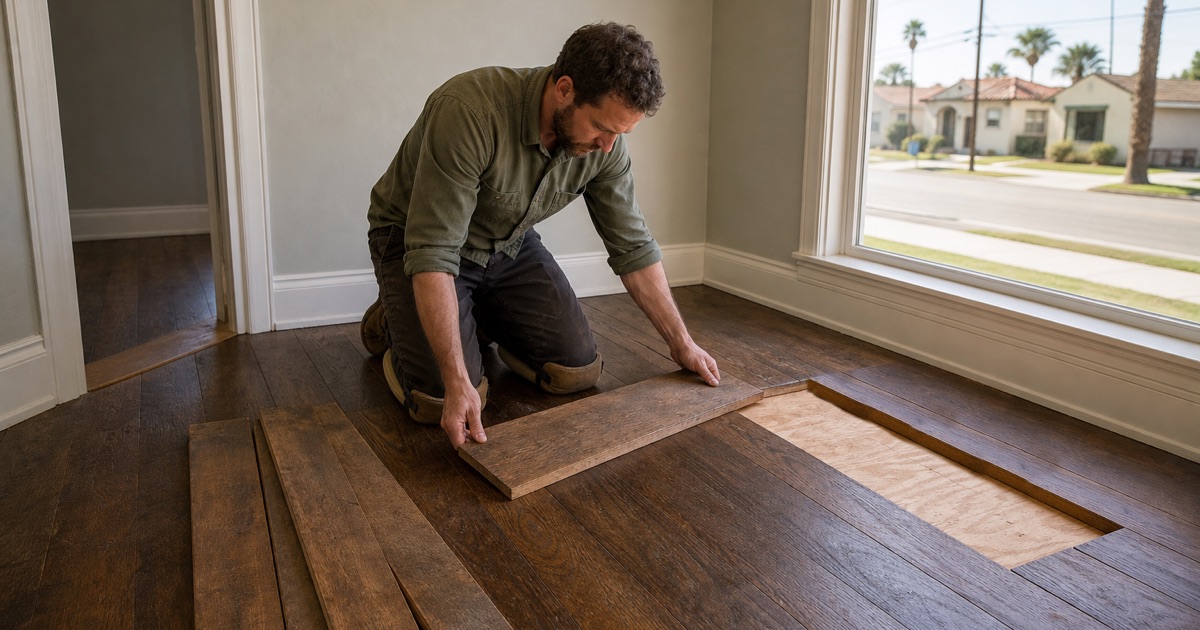
A rectangular patch dropped into a floor reads as a patch forever, because the eye follows the straight line of the joint around it. Weaving means staggering new boards into the existing field at varying lengths so no continuous seam exists anywhere. It takes longer, uses more material and wastes more offcut than a square patch. It is also the single technique that most determines whether a repair is visible, and it is the first thing we look at when somebody shows us a repair they are unhappy with.
Blending the Finish
New wood takes stain and finish quite differently from wood that has been down for ninety years and has darkened under a finish of its own. Matching means testing on offcuts, adjusting, and frequently toning the new material deliberately before the final coats go on. Where the surrounding finish has aged past the point where anything can be blended into it, refinishing the whole room is the honest recommendation. It costs more on the day and it is the only way to get a result that does not announce itself.
Choosing Where to Stop
A repair rarely needs to involve the whole house. Room boundaries and doorway thresholds are natural stopping points, because the eye does not carry a comparison across a threshold the way it does across an open floor. We plan that stopping point at the quote stage rather than discovering it during the work. A finished job should look deliberate at its edges, not like something that ran out of budget partway across a hallway.
What a Matched Repair Is Worth
Keeping the Original Floor
A floor from the 1930s is generally milled from timber that is no longer commercially available at that grade, in widths that stopped being standard decades ago. Replacing it wholesale means giving up better material than anything that would go back in its place. That is the argument for repair in one sentence, and it holds even where the repair costs a meaningful fraction of a new floor. The building keeps something that cannot be bought back, and the floor keeps the option of being refinished again in future.
Owners are rarely told this, because a replacement is a larger and simpler job to sell. We would rather set out the comparison and lose the bigger invoice than take out a floor that had thirty years left in it.
The Cost Difference in Practice
Replacing a floor means removing the old one, disposing of it, preparing the subfloor, buying and acclimating new material, installing it and then finishing it. Repairing means sourcing a limited quantity, replacing the affected boards, and refinishing a room. On a localized problem the second route is routinely a fraction of the first, even accounting for the sourcing time a period profile demands. Where the damage is spread across most of a floor, or the wear layer is genuinely spent, that arithmetic reverses and we say so.
The comparison is worth doing properly rather than assuming. It is the single decision on an old floor where the cheap-looking option and the correct option most often turn out to be the same one.
Recording What Was Done
A repair that is genuinely invisible creates its own problem: nobody in future knows it is there. We record the location, the species, the profile and the source of the material, so the next person sanding that floor knows what they are working across. That matters most on a floor with limited thickness left, where a repaired area may have slightly different remaining depth from the field around it. A contractor who knows that can work accordingly; one who does not will find out the hard way.
The same record makes a future repair far quicker. Matching a board is a sourcing exercise, and starting it with the species, width and profile already written down removes most of the work from it. It costs nothing to write down at the time and cannot be reconstructed later. On housing of this age the record is frequently the most durable part of the job.
We leave a copy with the owner rather than only keeping one ourselves. Contractors change, businesses close, and the document is only useful if it lives with the building it describes. On a street where much of the housing went up in the same decade, that record has a second use as well. Neighboring houses frequently share a species and a profile, so material sourced for one repair often solves the next one two doors down.
- Licensed & Insured
- Free Estimates
- 20+ Years Experience








