
Huntington Park Wood Flooring installs wide plank flooring and pattern floors in Huntington Park, CA and across Walnut Park, Florence-Graham, Maywood, Bell and Cudahy. Herringbone, chevron and wide plank are the three requests that come up most, and all three are more demanding to install than a standard strip floor.
The reason is worth stating plainly, because it is where most of the cost difference sits. A strip floor is forgiving: narrow boards absorb small errors in the subfloor and in the set-out, and any drift is easily corrected. Wide boards and pattern layouts are not forgiving at all. Both magnify whatever is underneath them and both punish an inaccurate starting line.
That means the preparation matters more than the material. A subfloor that is perfectly acceptable under narrow strip oak may need flattening before wide plank goes on it, and a pattern floor set out from a wall that is not square will drift visibly across the room. We survey and set out before ordering, not after.
Wide Plank
Why Width Changes the Engineering
A wide board moves considerably more across its width than a narrow one for the same change in moisture content, so seasonal gapping and cupping are both more pronounced. That makes moisture control, acclimation and correct fastening far more important. It also makes the choice between solid and engineered material a genuine engineering decision rather than a matter of preference.
Subfloor Flatness
Wide boards bridge dips in a subfloor instead of following them, which produces hollow spots that flex underfoot and eventually squeak or loosen. The subfloor has to be brought within a tighter flatness tolerance than narrow strip requires, using self-leveling compound or by addressing the structure. This is quoted openly, because it is usually the difference between a wide plank floor working and not.
Fastening and Adhesive
Wider boards generally need a closer fastening schedule and frequently a combination of mechanical fastening and adhesive, so the board is held across its width rather than only at its edges. Which combination applies depends on board width, thickness and the subfloor. Getting it wrong shows up as cupping and movement in the first season rather than immediately.
Herringbone and Chevron
The Difference Between Them
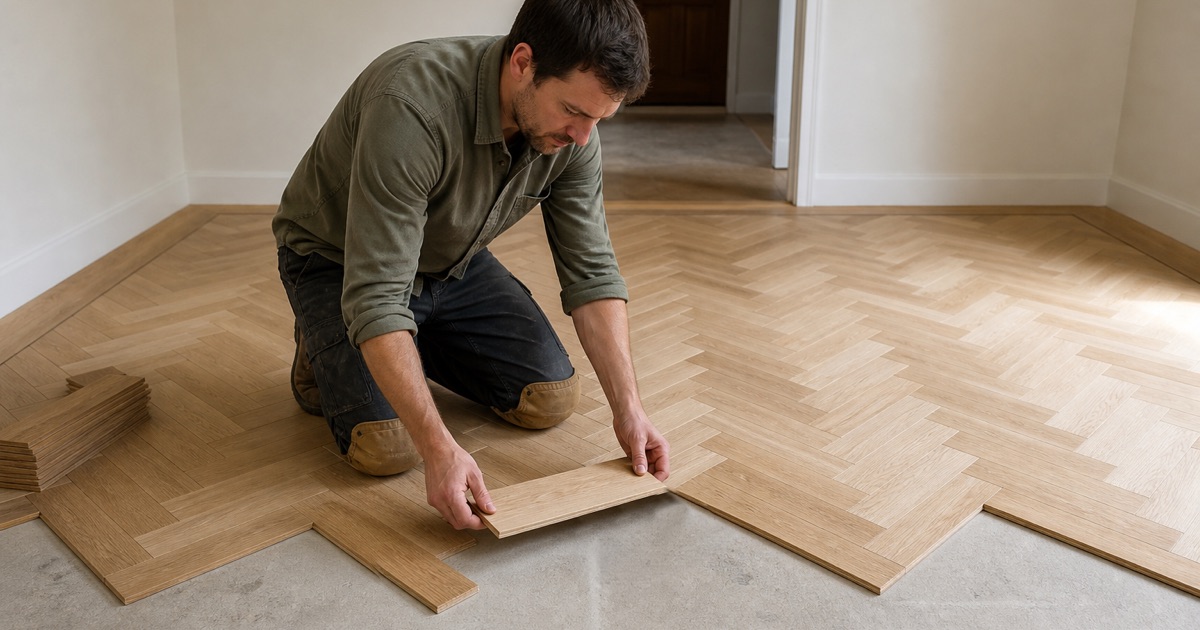
Herringbone uses rectangular blocks laid at right angles to each other, so the ends meet the sides in a staggered zigzag. Chevron uses boards cut at an angle at each end so they meet point to point in a continuous V. They look related and are quite different to install, and chevron requires precisely mitered material rather than standard blocks.
Set-Out and the Center Line
A pattern floor is set out from a center line established across the room, not from a wall, because walls in older buildings are rarely square or parallel. The pattern is dry-laid and checked before anything is fastened. An error of a few degrees at the start becomes a visibly crooked pattern at the far wall, and by then it cannot be corrected.
Waste, Borders and Room Shape
Pattern work generates substantially more offcut than a straight floor, which has to be allowed for in the material order. Borders and perimeter details frame the pattern and absorb the awkward angles where it meets the walls. Room shape matters more here than anywhere else, so we plan the layout to the actual room rather than to a standard.
Choosing Between Them
Matching the Floor to the House
Wide plank reads as informal and contemporary or rustic depending on grade and finish. Herringbone and chevron read as formal and period-appropriate, which suits the pre-war housing that makes up much of this area. Both are legitimate choices; what does not work is a pattern that fights the room it is in, and that is worth resolving before ordering.
Solid Against Engineered in Pattern Work
Engineered material is often the better answer for wide plank and for pattern work over a slab, because its stability is precisely what those formats need most. On a raised wood subfloor solid remains available for both. The subfloor generally decides it, with board width and pattern making the case for stability more strongly than a strip floor would.
Restoring an Existing Pattern Floor
Original Parquet and Block Floors
Pattern floors are not only a new-installation choice here. Original parquet and wood block floors turn up regularly in the pre-war housing across this area, frequently under carpet, and they are usually worth restoring rather than replacing. What is down is often better material and a better pattern than anything that would replace it.
Sanding a Pattern Floor
A pattern floor cannot be sanded the way a strip floor is, because the grain runs in several directions at once and a single-direction pass tears the wood where it meets cross grain. It is worked at an angle to the pattern and finished with a multi-disc machine, which takes longer and requires more care about how much material comes off.
Replacing Missing Blocks and Pieces
Individual blocks lift, go missing or get damaged, and matching replacements to an original pattern means finding material of the right species, thickness and dimension. Where blocks have lifted because the original adhesive has failed, that has to be addressed underneath rather than simply refixing the piece, or the same blocks will lift again.
- Licensed & Insured
- Free Estimates
- 20+ Years Experience