
Huntington Park Wood Flooring does wood flooring in Maywood mostly in buildings where somebody else is still living on the other side of the wall. Duplexes, triplexes and small converted buildings make up a large share of the work here, and that changes the job well before any sanding starts.
A single-family house can be emptied, worked and handed back. A two-unit building generally cannot. One tenant is moving out while the other is staying put, so the work has to happen inside one unit without making the rest of the building unusable, and without the neighbor bearing the cost of somebody else’s improvement.
That is a scheduling and containment problem as much as a flooring one. It is also entirely solvable, provided it is planned at the quoting stage rather than discovered on the first morning when a crew arrives and finds a shared staircase they cannot block.
Working in One Unit at a Time
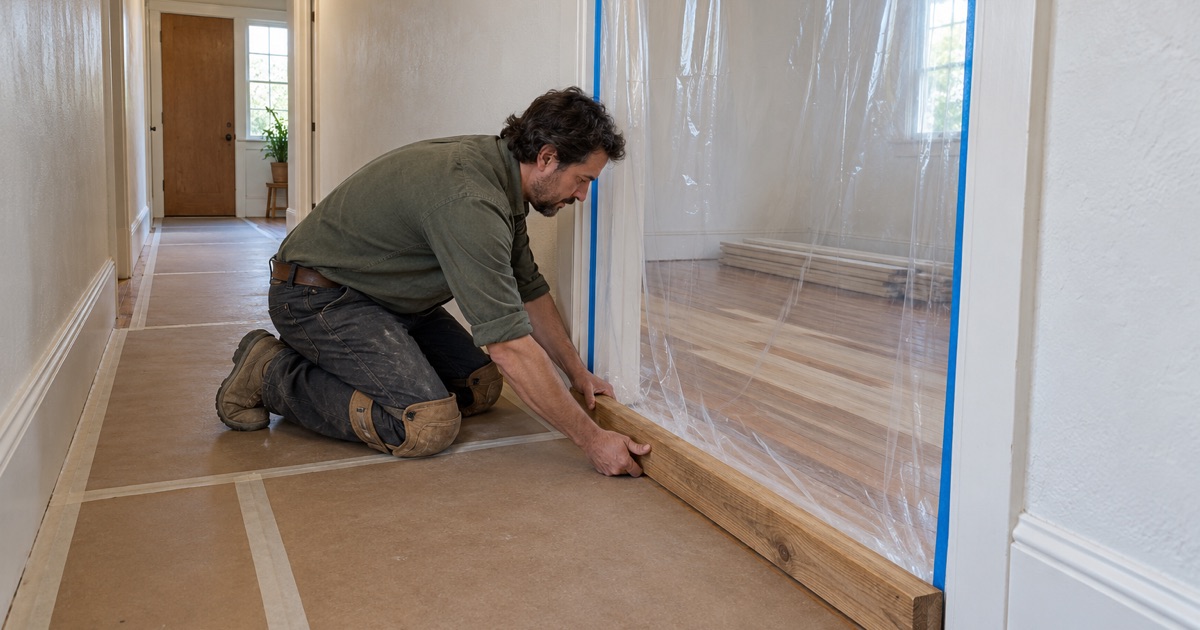
Containment at the Unit Door
The boundary of the work is the unit door, and it is sealed properly rather than draped. Dust is collected at the machine itself, and the working unit is kept at a pressure that moves air inward rather than out into a shared hallway. Nothing about that is exotic, and skipping it is what generates complaints.
The measure of success is simple: the occupied unit should not be able to tell by looking whether we were here today. Noise they will know about, and we handle that by scheduling rather than pretending. Dust arriving under a door is a different matter and is entirely preventable.
Where a building shares a heating or ventilation route between units, that gets closed off too. It is the path people forget, and it is the one that carries dust into a unit nobody has been working in.
Protecting the Shared Route
Material comes in and waste goes out along a route that other people use every day, frequently a single staircase or a narrow shared entry. That route gets protected before anything is carried along it, and it stays usable throughout rather than being blocked while a delivery sits on the landing. Maywood is a city in Los Angeles County and, at 1.18 square miles, the third-smallest incorporated city in the county by area. Lots here are tight, buildings sit close together, and the route from the street to the unit is frequently the constraint that shapes the whole working day.
Telling the Neighbor What to Expect
The occupant who is not paying for the work is the one most likely to be inconvenienced by it, and they are usually told least. We agree the noisy passes in advance and make sure the other unit knows which days those fall on, in whatever form the owner prefers to communicate it. That is not a courtesy so much as risk management. A neighbor who knows sanding runs Tuesday and Wednesday morning plans around it; a neighbor who finds out when it starts calls the owner, and the owner calls us.
Looking for wood flooring closer to Bell? See Wood Flooring in Bell.
Why So Much of the Work Here Is Multi-Unit
The Shape of the Housing
About 43.9% of the housing units here predate 1950 and 66.6% predates 1960, and only 30.5% of it is owner-occupied. Nearly seven units in ten are rented, which means most floor decisions in this city are made by somebody who does not live on the floor and will not be there when it is walked on. That changes what gets specified. Durability and turnaround matter more than they would to an owner-occupant, and the finish that looks best in a showroom is rarely the finish that survives four years of tenancy with the least intervention.
Small Buildings, Not Large Ones
The multifamily stock here is mostly small: duplexes, fourplexes and buildings of a handful of units, rather than large complexes with on-site management. That means the owner is often a single individual with one building, making decisions between other commitments, without a maintenance department to absorb the coordination. We work to that reality. Scopes are written so an owner can read them once and understand what is happening and when, and the scheduling is agreed with one person rather than routed through a management chain that does not exist.
Original Floors Under Rental Wear
Two thirds of this housing predates 1960, so a great deal of it has original hardwood that has been rented on for decades. Those floors have usually had wear rather than damage, and wear is what refinishing is for. What they have often also had is a series of quick fixes that need undoing first.
Establishing which is which is the first visit’s job. A floor that looks tired is frequently a floor that needs a recoat, and a floor that has been patched four times by four different people is a larger conversation. We would rather find the second sort before quoting than during sanding. Undoing somebody else’s repair is legitimate work and it belongs in the price from the start, not as a variation raised once the machines are already in the unit.
Scheduling a Building Rather Than a Room
Sequencing Units in Order
Where more than one unit is being done, the order matters. Working from the top of a building down, or from the far unit toward the entry, keeps finished floors out of the traffic route for material and waste. Getting that backwards means walking over new finish for a fortnight. We plan the sequence with the owner against their vacancy dates, so units come back into service in the order they are needed rather than in the order that happened to suit the crew.
Where a building has a single shared stair, that sequence is not really optional. Finished floors and carried material cannot use the same route in the same week without one of them suffering for it.
Fitting the Work to a Vacancy
The real cost of a turnover is rarely the flooring, it is the empty month. Where a unit is vacant, work is scheduled against the move-in date and finish systems are chosen partly on how quickly they return to service, so the floor is genuinely ready when the tenancy starts. That sometimes means a different product than we would specify for an owner-occupied house with no deadline, and we say so rather than quietly substituting. The trade-off is worth making deliberately.
Doing a Building Over Time
Not every owner can do a whole building at once, and there is no reason to. Units done at intervals as they turn over spread the cost across years, and provided the specification is recorded, the last unit can be matched to the first even if there are three years between them. We keep the species, product and finish on file for exactly that reason. A building refinished piecemeal without a record ends up with four different floors, and nobody decided that; it just happened one turnover at a time.
Getting Material In and Waste Out
The Route From the Street
Maywood is the third-smallest incorporated city in Los Angeles County by area, and the lots reflect it. Buildings sit close together, driveways are narrow or shared, and the distance from where a truck can legally stop to where the work is happening is frequently the thing that shapes the working day. We walk that route before quoting rather than on the first morning. Where material has to be carried a long way, or up a stair, or through a unit somebody is living in, that is real time and it belongs in the price rather than arriving as a surprise.
Staging Without Blocking Anyone
Flooring needs somewhere to sit while it acclimates, and on a tight lot there is rarely an obvious place for it. Staging in a shared hallway or across a driveway other residents use is not an option, so we agree a location with the owner in advance and keep it out of everybody’s way. Waste is the same problem in reverse. Old carpet, padding, tack strip and removed boards come out in volume, and where they wait for collection matters to people who did not ask for any of this to be happening.
Parking, Deliveries and the Working Day
On streets this dense, where the truck goes is a genuine constraint rather than a detail. A delivery that cannot get close adds an hour to a day, and repeated across a job it becomes real money that somebody has to absorb. We plan around it and say plainly where access will slow things down. An owner told at the quote stage that a rear unit adds a day to the schedule can decide what to do about it; an owner told afterwards has simply been handed a bill.
None of this is glamorous and all of it is why a job either runs to schedule or does not. On a building where somebody is still living upstairs, a day lost to an access problem is also another day of noise and disruption they did not agree to.
- Licensed & Insured
- Free Estimates
- 20+ Years Experience








