
Huntington Park Wood Flooring handles hardwood floor repair in Huntington Park, CA and the surrounding cities of Walnut Park, Florence-Graham, Maywood, Bell and Cudahy. After twenty years on this housing stock, most of the damage we are called to is familiar: a section ruined under a leaking appliance, boards gone soft at a doorway, a patch of pet damage, or a previous repair that was never matched properly.
Repair is almost always the first thing to consider on an old floor, and it is routinely skipped. A floor from the 1930s is generally made from timber that is no longer commercially available at that grade, so replacing it wholesale means giving up better material than anything that would go back down. Where the damage is localized, replacing the affected boards and refinishing the room costs a fraction of a new floor.
The reason repair gets skipped is that it is harder than replacement. Matching a board to something last milled eighty years ago takes sourcing and patience, and weaving it into the surrounding field so the join disappears takes skill that a tear-out does not require. That is the work, and it is what this page is about.
Assessing What Is Actually Wrong
Localized Damage Against a Failing Floor
The first question is whether the damage is confined or symptomatic. Boards ruined under a dishwasher are a contained problem. Boards cupping across an entire room usually mean moisture is arriving from underneath and replacing them without addressing that guarantees a repeat. We establish which of the two we are looking at before quoting, because they are different jobs with very different prices.
Structural Against Cosmetic
Some damage is only on the surface: scratches, worn finish, surface staining. Some has gone into the board or past it into the subfloor and joists. Soft spots underfoot, boards that move when stepped on, and any sign of rot or insect damage all point below the finish floor. We look underneath wherever there is crawl space access rather than guessing from above.
Previous Repairs
Old floors frequently carry earlier repairs, and a good many of them were done badly: face-nailed boards, a patch in the wrong species, a section running the wrong direction. These have to be identified before a new repair is planned, since working around a bad previous patch and simply replacing it are different scopes and the choice belongs to the owner rather than to us.
Matching the Material
Board Width and Milling Profile
Strip flooring from the pre-war period is generally narrower and thinner than anything sold today, and the tongue and groove profile has changed as well. A modern board will not simply drop into an old floor. We measure width, thickness and profile, then either source reclaimed stock or have boards milled to match, so the repair sits flush rather than proud or low.
Species, Cut and Grain
Getting the species right is only the start. Plainsawn, rift and quartered oak look substantially different from each other, and a quartersawn board with visible medullary ray fleck dropped into a plainsawn floor will stand out permanently regardless of finish. We match cut as well as species, and we look at grain and color across several boards before committing any of them.
Reclaimed and Custom-Milled Stock
Reclaimed material from the same era is often the best answer, because it has already done its moving and it matches the original in grade as well as species. Where reclaimed stock cannot be found in the right profile, boards are custom-milled. Both take longer to obtain than pulling flooring off a shelf, which is why we start sourcing early rather than at the point of installation.
Making the Repair Disappear
Weave-In Rather Than Patch
A rectangular patch dropped into a floor reads as a patch forever, because the eye follows the straight line of the joint. Weaving in means staggering the new boards into the existing field at varying lengths so no continuous seam exists. It takes longer and uses more material, and it is the difference between a repair you can see and one you cannot.
Blending the Finish
New wood takes stain and finish differently from wood that has been down for eighty years and has darkened. Matching the finish means testing on offcuts, adjusting, and sometimes deliberately toning the new boards before the final coats. Where the surrounding finish is too far gone to blend into, refinishing the whole room is often the honest recommendation.
Deciding Where to Stop
A repair does not always require refinishing the entire house. Room boundaries and doorway thresholds are natural stopping points where a change is invisible, because the eye does not carry a comparison across a threshold. We plan the stopping point at the quote stage so the finished result looks deliberate rather than trailing off partway across a floor.
Repairs on Rental and Multifamily Property
Damage Found at Turnover
Most turnover damage is localized and repairable: a water-stained section under a window that was left open, boards ruined where an appliance leaked, or a patch of pet damage in one room. Replacing those boards and recoating the room costs a fraction of a new floor and turns the unit around faster, which on a vacant unit is usually the number that actually matters.
Keeping the Original Material
On a pre-war building the existing floor is frequently better timber than anything that would replace it, and tenants are not the reason it wears out. Repairing preserves that material and preserves the option of refinishing again later. Tearing out an original floor to install a thin modern product is a decision that cannot be reversed at the next turnover.
Documenting Condition
Photographs and a written record of floor condition before and after a repair give an owner something concrete when a deposit is in question or when the same damage reappears. We supply that record with turnover work as a matter of course, because a recollection of what a floor looked like eighteen months ago settles no argument.
Our Step-by-Step Repair Process
Inspection and Diagnosis
We establish the extent of the damage, whether anything below the finish floor is involved, and whether the cause is still active. A leak that has not been fixed will ruin the repair. Where there is crawl space access we look from below, since a great deal of what causes floor damage is only visible from underneath.
Sourcing and Matching
Board width, thickness, species and cut are recorded and material is sourced to match, whether reclaimed or custom-milled. This is usually the longest part of the timeline on a period floor, and it is the part most often underestimated by anyone quoting a repair without having looked at the profile.
Removal and Replacement
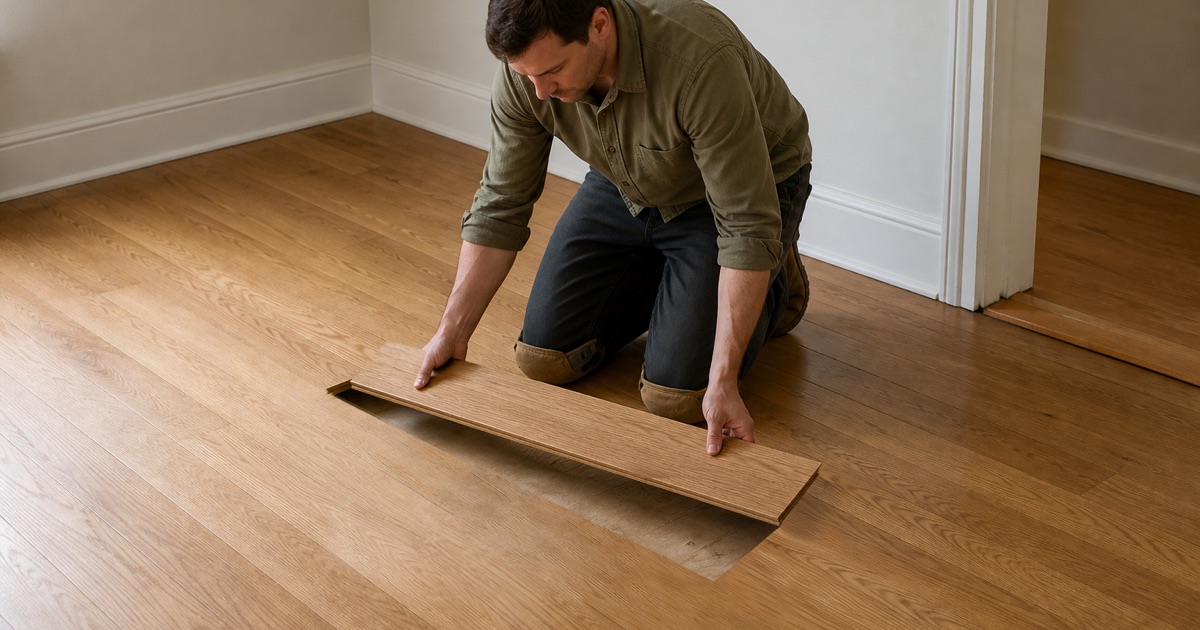
Damaged boards come out without disturbing their neighbors, the subfloor beneath is checked and repaired if needed, and new material is woven into the existing field at staggered lengths. Fasteners go in at the schedule appropriate to the board rather than wherever is convenient.
Sanding, Blending and Finishing
The repaired area is sanded flush with the surrounding floor and the finish is blended or the room is refinished, depending on what was agreed. We confirm the cure schedule in writing, because a repair that gets furniture dragged back over it too early is a repair that has to be done twice.
- Licensed & Insured
- Free Estimates
- 20+ Years Experience