
Huntington Park Wood Flooring has been doing wood floor refinishing in Huntington Park, CA for more than twenty years, serving surrounding cities including Walnut Park, Florence-Graham, Maywood, Bell and Cudahy. Most of that work is on floors laid before 1950, because that is most of what stands here, and an eighty-year-old floor is a different proposition from a modern one in almost every respect.
The difference that matters most is how much wood is left. A floor that has already been sanded two or three times has a limited amount of material above the tongue, and the entire question of whether it can be sanded again turns on that measurement rather than on how it looks. We take the measurement before quoting, not after starting, because it is the number that decides between a refinish, a recoat and a replacement.
The second question is how you live through the work. Roughly three quarters of the housing in this city is rented and just over half of it sits in buildings of two or more units, so a large share of these jobs happen with somebody occupying the building throughout. That shapes containment, sequencing and scheduling from the first day rather than being handled as an afterthought.
Deciding What the Floor Can Take
Measuring the Remaining Wear Layer
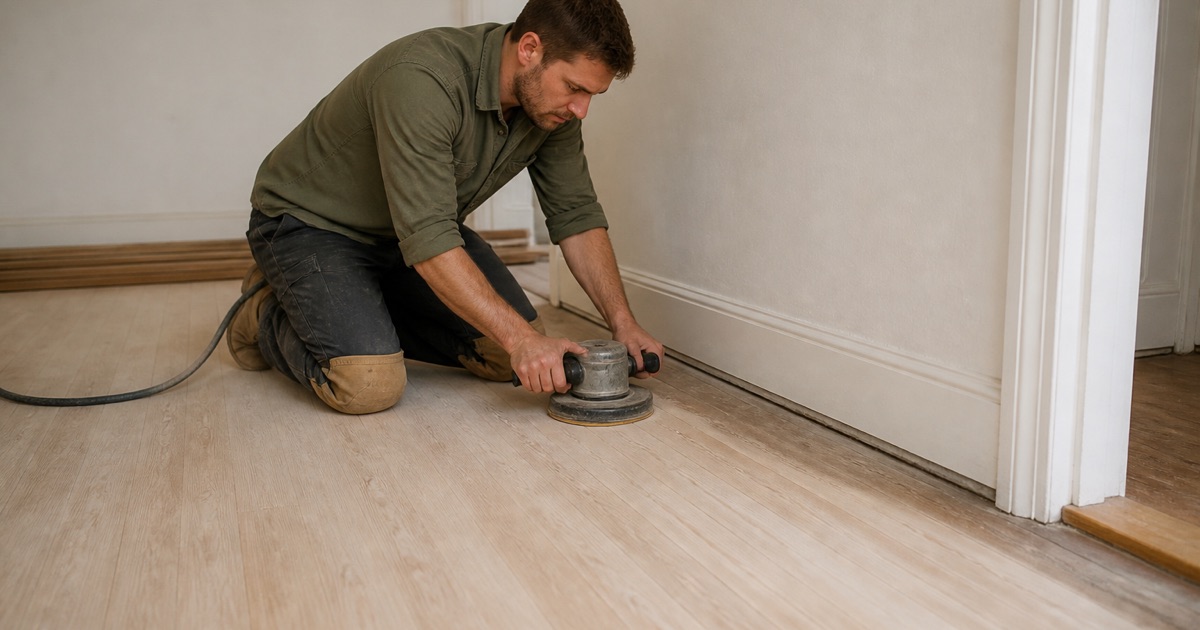
The usable wood on a solid floor is only what sits above the tongue, and on a pre-war strip floor that can be a surprisingly thin margin. We measure it directly at a threshold, a floor register or any cut edge rather than estimating from the surface, because the surface tells you nothing about what is underneath. That figure determines whether a full sand is available at all, and it goes into the written scope so the decision rests on a measurement anyone can check rather than on an opinion formed in a doorway.
Reading the Sanding History
Fastener heads sitting close to the surface, a pronounced lip where the floor meets a threshold, and boards gone thin around the perimeter all indicate previous refinishing work. Counting those signs tells us how much life the floor has already spent. A floor with one sanding left is worth treating very differently from one with three, and none of that difference is visible to a casual look at a clean, polished surface.
Species and Grade Identification
Oak, Douglas fir, hard maple and the occasional American cherry all behave differently under an abrasive, and softwoods need a far gentler opening cut than oak will tolerate. We identify what is actually on the floor before selecting a grit sequence. The fastest way to ruin a fir floor is to open it with the aggressive first pass that oak needs, and by the time that shows it cannot be undone.
The Sanding Itself
The Grit Sequence
A full sand typically runs 36 then 50 then 80 grit, each pass removing the scratch pattern left by the one before it. Skipping a grade to save an hour leaves a deeper scratch that the finish then magnifies rather than hides, and it shows in daylight even when it looked acceptable under work lights. We run the full sequence and inspect the floor between passes, because a missed scratch pattern is far cheaper to catch at 50 grit than after three coats of finish.
Edges, Corners and Closets
A drum sander cannot reach a wall, so the perimeter, the closets, the stair landings and anywhere a large machine will not fit are worked with an edger and finished by hand. Blending that perimeter invisibly into the field is the part of the job that separates a good refinish from an obvious one. It also takes a disproportionate share of the labor, which is why a quote that looks unusually cheap is often a quote that has not budgeted for it.
Dust Collection and Containment
Dust is captured at the machine and contained at the openings with controlled airflow, rather than swept up afterwards. No system captures every particle and we will not claim one does. What proper containment delivers is a house that stays livable through the work and, in a duplex or a small apartment building, a neighboring unit that does not end up coated in fine oak dust that takes weeks to stop appearing.
Choosing a Finish
Waterborne, Oil-Modified and Hardwax Oil
Waterborne finishes dry quickly and stay clear over their life. Oil-modified polyurethane ambers as it ages, which some people want and some do not, and is extremely hard-wearing. Hardwax oil penetrates the wood rather than forming a film over it, and can be spot-repaired without recoating an entire room. Traffic levels, your timeline and how the floor will be maintained decide which of the three fits, and they genuinely suit different situations.
The 275 Gram Per Liter Limit
Wood coatings applied in this air basin are limited to 275 grams per liter of volatile organic compounds by the South Coast air district, and that limit reaches the contractor applying the product rather than only the manufacturer selling it. We specify from compliant products at the quoting stage. A finish that is perfectly ordinary elsewhere in the country can be unusable here, and finding that out midway through a job is nobody’s idea of a good outcome.
Sheen, and What It Reveals
A higher gloss reflects more light and shows every particle of dust, every footprint and every minor scratch that will inevitably arrive. Satin and matte conceal a great deal more and read as more contemporary. In rooms taking strong afternoon light the difference between them is dramatic rather than subtle, so we look at samples in the actual room, at the time of day the room is used, rather than choosing from a chart.
Screen and Recoat, and When It Is Enough
Abrading Rather Than Sanding
Where the finish is worn but the wood beneath it is sound, a screen and recoat abrades the existing surface and adds a fresh coat without removing any wood. It is faster, costs considerably less, and leaves the floor as thick as it was. Wherever a floor genuinely qualifies we recommend it, because it banks a full sanding for a later decade instead of spending it now on a problem that did not require it.
Knowing When It Will Not Work
A screen and recoat cannot address damage that has reached the wood: stains that have penetrated, deep scratches, cupping, or areas where the finish has already worn through to bare timber. Recoating over any of those seals the problem under a new film where it stays visible and gets worse. We check for all of them before recommending a recoat, because the cheaper option is only cheaper if it actually works.
Cure Time Against Dry Time
Dry means the surface is no longer tacky. Cured means the finish has reached full hardness, which takes substantially longer, and the gap between the two is when most new floors get damaged. We give the actual schedule for the product going down, including when rugs and heavy furniture can safely return, in writing before the work starts rather than as a verbal aside on the last day.
Our Step-by-Step Refinishing Process
Assessment and Measurement
We measure the remaining wear layer, identify the species, check for previous repairs and look for anything that has to be dealt with before sanding: protruding fasteners, loose boards, water damage. This visit is what the quote is built from, and it is where a floor that cannot be sanded gets identified before anyone has committed money to sanding it.
Preparation and Containment
Fasteners come out, loose boards are secured, and any board replacement happens before abrasive touches the floor. Work areas are sealed and dust collection is set up at the machine. In an occupied building this is also when the schedule for the noisy passes is confirmed with whoever else is in the building.
Sanding and Edging
The floor is taken through its full grit sequence, with the perimeter, corners and closets worked separately and blended into the field. The floor is inspected between passes under proper lighting, because a scratch pattern that survives to the finish stage is a scratch pattern that stays there permanently.
Finishing and Cure
Coats go on to the schedule for the specified system, with the floor checked between them. We confirm in writing when light foot traffic is acceptable and when rugs and furniture can return, since those are two different dates and treating them as one is the most common way a new finish gets marked in its first month.
- Licensed & Insured
- Free Estimates
- 20+ Years Experience