
Huntington Park Wood Flooring handles wood flooring in Florence-Graham, and a large share of that work begins with carpet rather than with wood. The most common question we are asked here is whether there is a floor underneath at all, and the second is what state it will turn out to be in. Both are answerable in roughly five minutes, and neither is answerable by guessing. Lifting a corner in a closet or behind a door reveals the species, the board width and roughly what condition the surface is in, which is enough to decide whether uncovering the rest is worth the money.
What that check will not tell you is what the carpet has done to the floor around its edges, and that is usually where the real cost of the job sits. This page covers the whole sequence: finding out what is there, and understanding what taking the covering off actually involves.
Finding Out What Is Underneath
The Test Lift
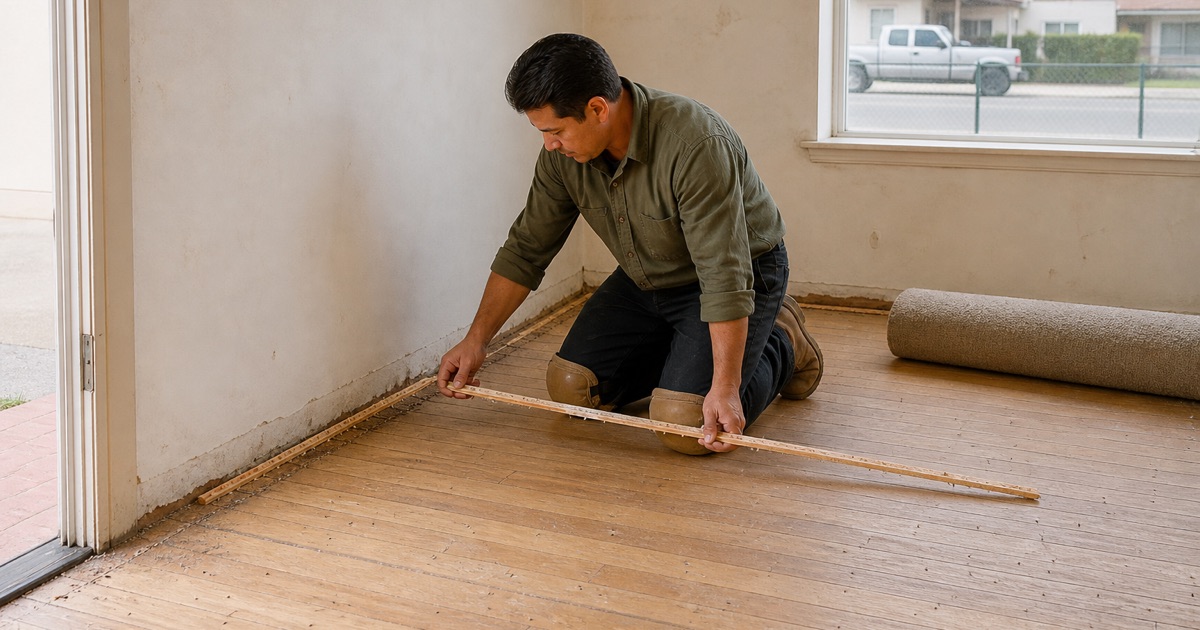
A small section of carpet and padding comes up somewhere inconspicuous, ideally a closet where nothing shows if the answer disappoints. Underneath there is either hardwood, a plywood or board subfloor, or a concrete slab. Only the first of those is a floor; the other two mean the wood was never laid or has already been taken out.
Where there is wood, we note the species, the board width and the nominal thickness, and look at how the surface has fared under decades of covering. That is enough information to say whether this is a straightforward refinishing job or something considerably larger, and it costs nothing to establish.
What the Odds Actually Are
About 47.3% of the housing units here predate 1950 and 62.5% predates 1960, and houses of that era were generally built with hardwood as standard rather than as an upgrade. Florence-Graham is a census-designated place in Los Angeles County taking in the communities of Florence, Firestone Park and Graham, and its stock is old enough that original wood is a reasonable expectation.
That does not make it a certainty, and we are careful not to present it as one. Floors get replaced, damaged past saving, or covered precisely because they had already failed. The lift is what settles the question, and until it happens everything else is speculation.
Carpet as Preservation
Carpet is hard on the edges of a floor and remarkably easy on the middle of it. A floor that has spent forty years under carpet has been shielded from sunlight, foot traffic and spills across almost all of its area, so the field is frequently in better condition than a comparable floor that stayed exposed the whole time. That is the genuinely good news in this kind of work, and it is why uncovering so often turns out to be worth doing. The floor that emerges is regularly better than the owner expected, and better than anything that could be bought to replace it at the same price.
The pattern is consistent enough to be worth relying on. Where a floor was covered because tastes changed rather than because it had failed, the wood underneath has effectively been in storage, and the work becomes restoration rather than rescue. Looking for wood flooring closer to Maywood? See Maywood Wood Flooring.
What the Carpet Leaves Behind
Tack Strip Damage at the Perimeter
Tack strip is nailed down around the entire perimeter of every carpeted room, which means a continuous band of nail holes and splitting around the edge of whatever is underneath. On an old floor those nails have frequently split the boards nearest the wall, and that damage sits exactly where a large sanding machine cannot easily reach.
Sometimes the damaged band falls under where the baseboard and shoe molding will finish, and it simply disappears. Sometimes boards have to be replaced along the whole wall. We look at the perimeter specifically when assessing, because that is the part that decides which of those two jobs you are buying.
Staples, and Why Every One Matters
Carpet padding is stapled down, often at a few inches spacing across the entire floor, which can mean several thousand staples in a single average room. Every one has to be pulled by hand before any abrasive touches the wood, because a single missed staple will tear a sanding belt and score a line across the boards as it goes. This is slow, unglamorous work and it belongs as a real line in any honest quote for uncovering a carpeted floor. A price that does not obviously account for it is a price that will change once the work starts, which helps nobody and sours a job that should have been straightforward.
Adhesive, Tar Paper and Older Coverings
Underneath the carpet there is frequently something older again: rosin paper, tar paper, or the black cutback adhesive used beneath linoleum and tile. Each behaves differently and adhesive in particular often needs scraping before sanding rather than being taken off by the machine as it passes. Where a covering predates 1978 there is also the question of what is in the paint underneath it, and lead-safe work practices apply to disturbing paint in housing of that age. We establish what we are dealing with before starting rather than discovering it partway through and having to stop.
Deciding Whether to Uncover
Weighing the Real Cost
The cost of uncovering is carpet removal, staple pulling, adhesive work, perimeter repairs and then the refinishing itself. Set against it is a floor that is generally better material than anything that would replace it, and one that can be refinished again in future rather than being a single-life product bought off a shelf. We price both routes honestly, including the case for leaving the carpet exactly where it is. An owner is entitled to see that comparison laid out rather than being talked into the larger and more interesting job by somebody who benefits from it.
Room by Room Rather Than All at Once
There is no requirement to uncover a whole house in one go. Doorway thresholds are natural stopping points, and a house can perfectly well have wood in its main rooms and carpet elsewhere without looking unfinished, as long as the transitions are detailed deliberately rather than covered with whatever strip is nearest. For an owner spreading cost across a few years, or a landlord working through a building unit by unit, that flexibility is usually the thing that makes the project possible at all. It also lets the first room prove the approach before the rest is committed.
When the Answer Is No
Occasionally the test lift reveals a floor that is not worth recovering: damage across too much of its area, too little wood left above the tongue, or a subfloor problem that has to be dealt with regardless of what goes on top. We say so plainly at that point rather than after the carpet is already in a skip. An honest answer at the test-lift stage costs an hour of somebody’s time. The same answer arriving three days into a job costs the carpet, the labor already spent, and the goodwill, and it is entirely avoidable by looking first.
Where that happens we price the alternative properly rather than walking away from it. A floor that cannot be saved still has to be replaced by something, and an owner who has just had bad news deserves a real number for the next option rather than a second appointment.
After the Carpet Comes Up
Letting the Floor Settle
A floor that has been sealed under carpet and padding for decades has been in its own microclimate, and it needs a short period exposed to the conditions of the house before it is sanded. Boards that have been covered can move slightly once they are breathing again, and sanding during that movement produces a floor that is flat only briefly. We measure moisture content rather than working to a fixed number of days, because the right interval depends on the house and the season. It is rarely long, and it is a great deal shorter than the time it takes to correct a floor sanded too early.
Deciding on Repairs First
With the floor fully exposed, the perimeter damage, any water staining and any structural movement become visible for the first time. That is the moment to decide what gets replaced, because board replacement happens before sanding rather than after, and finding another problem mid-sand means stopping and starting again. We walk the exposed floor with the owner before any machine comes in. It is the one point where everybody can see the same thing at the same time, and decisions made there tend to be better than decisions made from a photograph.
Finishing to Suit the Room
An uncovered floor is usually going into a room that has been carpeted for a generation, so the owner is seeing wood in that space for the first time. Sheen matters more than people expect: a higher gloss shows every particle of dust and every scratch, while satin and matte conceal considerably more and read as less formal. We look at samples in the actual room and at the time of day it gets used. A floor that has been hidden for forty years is worth a few minutes of that consideration rather than being finished with whatever was on the van.
- Licensed & Insured
- Free Estimates
- 20+ Years Experience








