
Huntington Park Wood Flooring is asked about wood flooring in East Los Angeles most often in houses where nothing has been done to the floor for a very long time. Not neglected exactly, but covered, patched, covered again, and left, across enough decades that nobody currently involved knows what is underneath. Roughly 50.6% of the housing units predate 1950 while 64.8% predates 1960, and only about a third is owner-occupied, so a great many of these floors have been rented on continuously for decades.
That produces a particular kind of job. The floor is usually original and usually salvageable, and it has accumulated forty years of small decisions made by people who were not planning to stay. Sorting that out is what this page is about.
What Decades of Deferral Look Like
Layers Rather Than a Floor
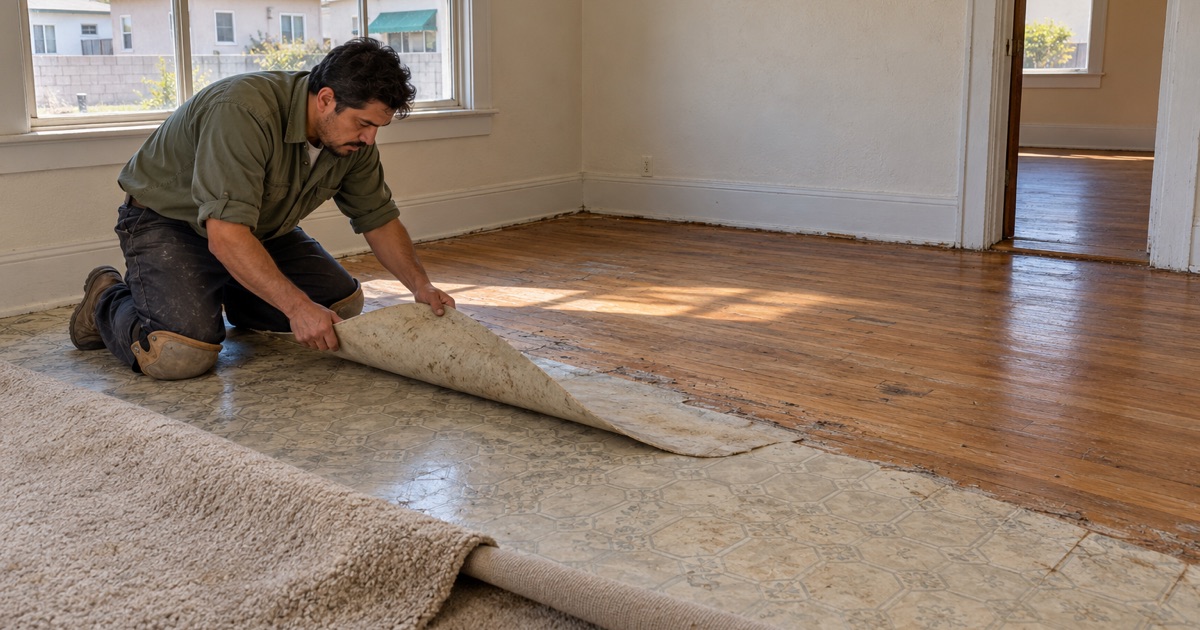
The typical find here is not one covering but several: carpet over vinyl over linoleum over the original boards, each added because replacing the one below it was more expensive than covering it. Each layer has its own adhesive, its own fasteners and its own damage.
We establish how many layers there are before quoting, because the number changes the job substantially. Removing three coverings is not three times the work of removing one, but it is a long way from being the same job. This is the largest place we cover, at around 32,141 housing units.
The good news is consistent: the deeper the layers, the longer the original floor has been protected. A board that has been under covering since 1970 has been shielded from everything that wears a floor out.
Patches Made From Whatever Was Available
Floors like these carry decades of small repairs made under time pressure with whatever material was to hand. Boards in the wrong species, sections running the wrong direction, face-nailed fixes and plywood over a hole all turn up regularly. None of that is a disaster and all of it has to be identified before a scope can be written. Whether a bad patch gets worked around, replaced, or simply refinished over is a real decision with a real price attached to each option.
We map them room by room rather than pricing an average across the house. Averaging hides exactly the room that needs the most work, and that room is where a quote goes wrong.
Damage That Accumulated Slowly
Deferred floors rarely have one dramatic problem. They have a slow accumulation: a long-ago leak that dried on its own, a section worn thin in a doorway, movement where a joist gave up, and staining nobody has thought about in years. Individually most of it is minor. Together it determines whether a floor takes a single refinish or needs staged work, and it is only visible once the coverings are off and the floor can be walked and looked at properly.
That is why we survey with the floor exposed wherever possible before committing to a full scope. A quote written from a photograph of a carpeted room is a guess wearing a number. Looking for wood flooring closer to Downtown Los Angeles? See Downtown Los Angeles Wood Flooring.
Surveying Before Committing
Test Lifts in Several Rooms
One test lift tells you about one room. In a house that has been altered and covered repeatedly, rooms genuinely differ, and the room with the original floor in good order may be next to one where the floor was taken out in 1985. So we lift in several places rather than extrapolating from the first. It takes an extra half hour and it is the difference between a quote that holds and a quote that gets revised twice.
East Los Angeles is an unincorporated community and census-designated place rather than a city, which means building matters fall to the county rather than to a city hall. That is worth knowing before anybody plans structural work.
Measuring What Is Left
On floors this old the governing number is how much wood sits above the tongue. Decades of covering protect a floor from wear but tell you nothing about how many times it was sanded before the covering went down. We measure at a threshold, a register or a cut edge in each area with original floor. A house can genuinely have one room with plenty of thickness left and another that has nothing, depending on what happened room by room over eighty years.
Those figures go in the written scope. On a house being restored in stages, they are also what decides which rooms are worth doing first.
Establishing What Is Structural
Some of what looks like a flooring problem is a subfloor or joist problem, and on raised construction of this age that is common enough to check as a matter of routine. Soft spots, movement and any smell of damp all point below the finish floor. Where there is crawl space access we look from underneath. It takes twenty minutes and it regularly changes a scope from flooring work to structural work with flooring on top.
Finding that now is the entire point. Structural problems are cheap to correct while a floor is open and expensive once a new floor is over them.
Restoring in Stages
Doing Rooms in Priority Order
Very few owners of a house like this can do everything at once, and there is rarely a reason to. Rooms can be taken in order of use, of condition, or of what is urgent structurally, and the rest left as they are until money and time allow. We set out that order with the owner rather than deciding it. The room that matters most to somebody living in the house is not always the room in the worst condition, and both are legitimate ways to sequence.
What matters is that the specification is recorded, so the room done in three years still matches the room done today. Without that a staged restoration ends up as several unrelated floors.
Stabilizing Before Improving
Where money is limited, the first spend should go on anything getting worse: active moisture, structural movement, boards deteriorating. Cosmetic work on a floor with a live problem underneath is money spent twice. That sometimes means the first phase produces very little visible improvement, which is a hard thing to sell and the right advice anyway. We explain what is being bought and why it comes first.
Once a floor is stable it can wait indefinitely without getting worse, which turns an urgent problem into a planned one. That is frequently the most valuable outcome of a first phase.
Knowing When to Stop
Not every floor in a house like this is worth restoring. Where a room has had its original floor removed, or has been damaged past any economic repair, the honest answer is to treat it separately rather than forcing consistency across the house. We price the realistic option for each room rather than one approach applied everywhere. A house with four restored original floors and two sensibly replaced ones is a better outcome than a compromise applied uniformly.
Owners generally find that easier to plan around than a single large number. It also lets the work stop at a sensible point rather than running until the budget does.
Working in a Tenanted House
Who the Decision Belongs To
Only about a third of the housing here is owner-occupied, so most of these floors belong to somebody who does not live on them. The person who reports a problem and the person who authorizes the work are usually different people with different priorities. We report findings in writing to whoever holds responsibility, with enough photographs and detail that a decision can be made without a second visit. That matters most where an owner is not local and cannot simply come and look.
It also keeps the occupant out of a position they should not be in. A tenant relaying a contractor’s verbal assessment to a landlord is a poor channel for a decision that involves structural work.
Timing Around a Tenancy
The cheapest moment to do floor work is when a unit is empty, and in long-tenanted housing those moments are rare and short. Where one arrives, it is worth having a scope already agreed so the work can start rather than being quoted from scratch. We survey ahead of a vacancy where an owner asks, so the pricing and the material sourcing are settled before the unit is empty. On a floor needing period boards, sourcing alone can take longer than the vacancy.
Where work has to happen with the household in place, it is phased room by room with containment, and the sequence is agreed with whoever is living there rather than imposed.
Documenting Condition
Photographs and a written note of floor condition before and after work protect everybody involved. They settle deposit questions, they record what was already damaged, and they give an owner a baseline for the next tenancy. On a floor that has been rented on for decades this record is frequently the first one that has ever existed. That alone makes it worth the twenty minutes it takes.
It also compounds. An owner with condition records across several tenancies can see which damage keeps recurring and whether it is the floor, the building or the use that is causing it.
- Licensed & Insured
- Free Estimates
- 20+ Years Experience








