
Huntington Park Wood Flooring handles hardwood floor repair in Downey most often for one damaged area in an otherwise sound floor. A dishwasher leaked, something heavy was dropped, a section by a slider took years of sun and grit, and the rest of the house is perfectly fine. The question that follows is always the same: does fixing that area mean refinishing everything. Usually it does not, and the difference between those two answers is most of the cost, so it is worth establishing properly rather than assuming.
What decides it is not the damage. It is how far the surrounding finish has aged, and whether a repaired area can be blended into it convincingly. That is a judgment made on the floor rather than from a description over the phone.
Deciding How Far the Work Has to Reach
What the Existing Finish Will Accept
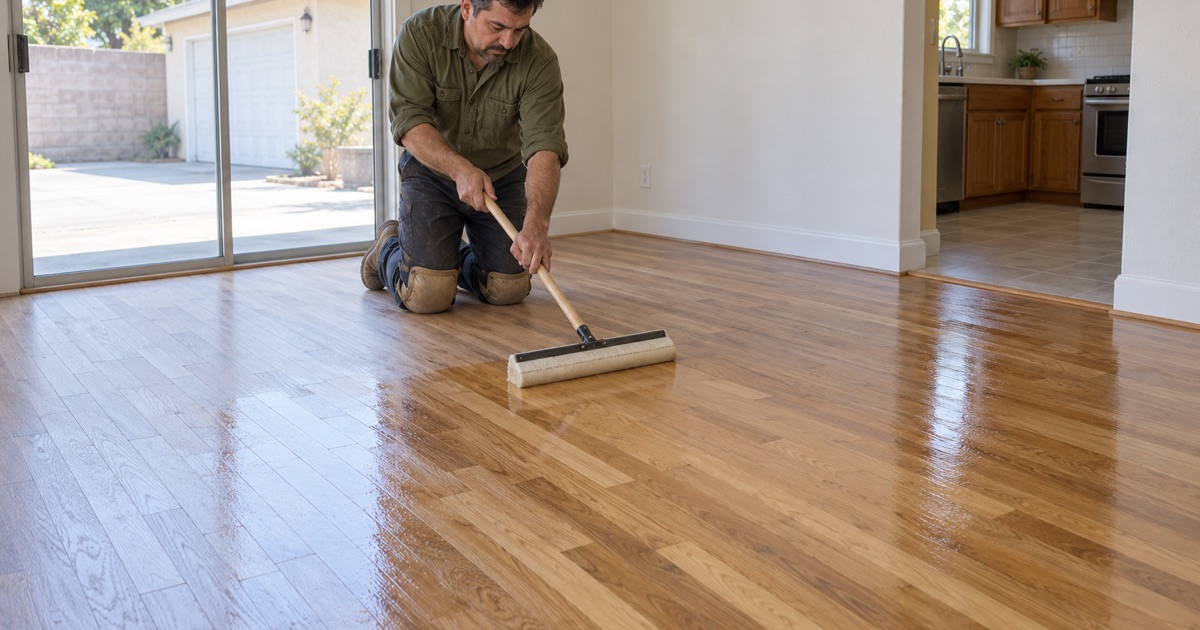
A finish that is a few years old and has worn evenly will usually take a blended repair without the join showing. A finish that has ambered heavily, faded unevenly under a window, or worn through in traffic lanes is much harder to match into. We test rather than guess, applying the intended finish to an offcut and comparing it against the floor in the room’s own light. It takes very little time and it settles the question before anybody commits.
Where the answer is that it cannot be blended, we say so and price refinishing that room rather than delivering a repair that announces itself. A visible patch is worse than having done the larger job.
Stopping at a Room Boundary
Doorways and thresholds are natural stopping points because the eye does not carry a comparison across them. Two rooms finished years apart look entirely normal; two halves of one room finished years apart do not. So the practical question is rarely whether to do the whole house. It is whether the work stops at the damaged area or extends to the boundary of that room, and both are legitimate depending on how the finish compares.
We plan that at the quote stage rather than deciding it partway through. A finished job should look deliberate at its edges rather than as though the budget ran out in a hallway.
Downey’s Housing and What It Means
Downey is a city in southeastern Los Angeles County, thirteen miles southeast of Downtown Los Angeles, with a population of 114,355 at the 2020 census. Around 14.9% of its housing units predate 1950 while 53.5% predates 1960, which makes it predominantly postwar. That matters for repair because postwar floors are generally a more consistent product than pre-war ones, milled to dimensions that are easier to match. Sourcing a board for a 1955 floor is usually simpler than for a 1925 one.
It also means many of these floors are on slab rather than raised construction, which changes what a repair involves underneath and whether moisture is a factor in what caused the damage. Looking for wood flooring closer to Compton? See Compton Wood Flooring.
Making the Repair Itself
Removing Only What Has to Go
Damaged boards come out without disturbing their neighbors, which on a tongue and groove floor takes more care than it sounds. Taking out more than necessary makes the repair bigger, harder to blend and more expensive for no benefit. We cut back to sound material and no further. Where damage extends under a wall or a fixed cabinet, the repair is planned to stop at a line that can be concealed rather than opened up unnecessarily.
What comes out gets kept until the repair is complete. It is the best possible reference for species, width, thickness and profile when sourcing the replacement.
Weaving the New Boards In
New material is woven into the existing field at staggered lengths rather than dropped in as a rectangle. A straight joint running across a floor is what makes a repair visible, because the eye follows the line. Staggering takes longer and uses more material, and it is the single technique that most determines whether the repair can be found afterwards. It is also the first thing we look at when somebody shows us a repair they are unhappy with.
Board direction matters equally. New material running against the direction of the field is visible from across a room regardless of how well the color matches.
Checking Underneath First
Damage on the surface frequently has a cause below it. A leak that has not been fixed, a slab that is moving moisture, or a subfloor that has deteriorated will all ruin a repair laid over them.
Where the floor is on a slab we test moisture with in-situ probes before putting anything back. Where it is raised and there is crawl space access, we look from below. Either takes very little time and regularly changes the scope.
Repairing above an active cause is work that has to be done twice. We would rather identify it and say so than take on a repair we expect to fail.
Blending and Finishing
Matching an Aged Finish
New wood takes stain and finish differently from timber that has been down for decades and has darkened under a finish of its own. Matching means testing on offcuts, adjusting, and frequently toning the new material before the final coats go on. That work is done before anything is applied to the floor, on samples, where it costs nothing to get wrong. Adjusting on the actual floor is how a repair ends up needing to be redone.
Where a match cannot be achieved to a standard worth paying for, refinishing the room is the honest recommendation. We would rather have that conversation at the start than deliver something the owner looks at every day.
Feathering a Recoat
Where the repair is small and the surrounding finish is sound, the new area can be finished and the surrounding floor screened and recoated so the whole room shares one top coat. That evens out any residual difference. It costs more than finishing the repair alone and considerably less than a full sand. On many repairs it is the sensible middle option, and it is frequently not offered by contractors who deal only in whole-room refinishing.
Whether it is available depends on the condition of the existing finish. A floor already worn through to bare wood in traffic areas cannot be recoated and needs sanding.
What the Owner Should Be Left With
At the end of a repair we record what was replaced, where, in what species and profile, and what finish was used. On a floor that will be repaired or refinished again one day, that record saves the next person from working it out. We also confirm cure times in writing. A repair that has furniture dragged back across it before the finish has hardened is a repair that gets damaged in its first week.
Where material was sourced specially, any usable remainder is left with the owner. It is the easiest possible answer to the next repair, and it costs nothing to keep.
When Repair Is Not the Answer
Damage Spread Across the Floor
Repair works because it is localized. Where damage appears in several rooms, or across most of one, the arithmetic changes: the sourcing, the labor and the blending across many areas add up past the cost of refinishing the whole thing.
We total it honestly rather than quoting repair by repair until it exceeds what a refinish would have cost. An owner is entitled to see both numbers side by side before choosing. That comparison is genuinely close more often than people expect, which is why it is worth doing properly rather than assuming repair is always cheaper.
A Floor With Nothing Left to Sand
A repair usually ends with sanding the area flush and blending the finish. On a floor that has already been sanded to its limit, there may not be enough wood above the tongue to do that safely. We measure before committing, at a threshold or a cut edge. Where the answer is that the floor cannot take another cut, repair options narrow to board replacement with a finish applied only to the new material.
That is sometimes still the right call, particularly where the alternative is replacing a floor that is otherwise serving perfectly well. It just has to be a decision made knowingly.
An Active Cause Underneath
Where damage is being produced by something still happening, repair is premature regardless of cost. A slab moving moisture, an unresolved leak or a failing subfloor will damage new material exactly as it damaged the old. We identify the cause and say what has to happen first, even where that falls to another trade. Taking on flooring work above a live problem is not something we do.
Once the cause is dealt with, the repair is usually straightforward and frequently smaller than it looked. Waiting is not a delay so much as the first stage of the work. We would rather explain that than take on a repair we expect to fail. It is a short conversation and it saves an owner from paying for the same work twice.
- Licensed & Insured
- Free Estimates
- 20+ Years Experience








