
Huntington Park Wood Flooring gets called about wood flooring in Compton for noise as often as for appearance. A floor that squeaks in the same spot every time somebody crosses it is one of the most common complaints in this city’s housing, and one of the most commonly misdiagnosed. The reason is that a squeak sounds like it is coming from the boards, and it usually is not. It is generally movement somewhere in the layers underneath, transmitted up through a floor that is doing nothing wrong itself.
Compton is one of the oldest cities in Los Angeles County, the eighth to incorporate back in May 1888, and around 30.1% of its housing units predate 1950 with 58.6% predating 1960. A lot of that is raised construction, which is exactly the assembly where squeaks develop.
What a Squeak Actually Is
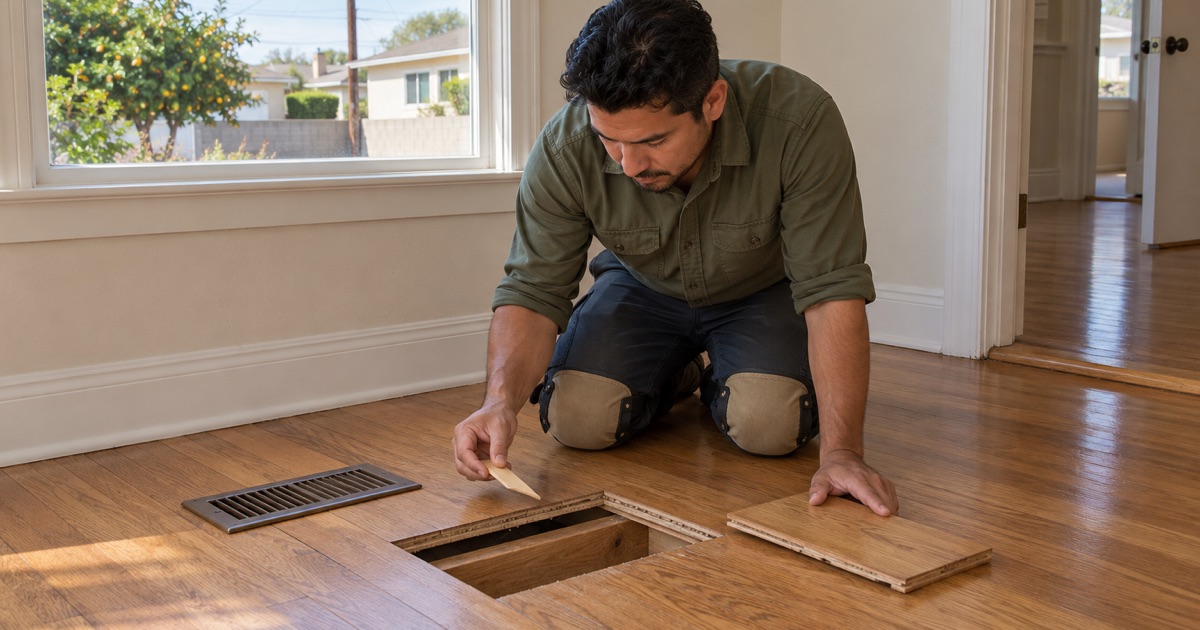
Movement Between Layers
A squeak is friction. Two components move against each other under load and the sound is what that movement produces: a board against a fastener, a subfloor lifting off a joist and dropping back, a fastener working in its hole. That means the noise locates the movement but not necessarily the fault. A squeak heard in the middle of a room can be produced by a joist several feet away, because the whole assembly deflects together.
Finding the actual source is therefore a diagnostic job before it is a repair job. Fixing where the noise is heard rather than where the movement is happening is why so many squeak repairs do not work.
The Usual Culprit
Most often it is the subfloor separating slightly from the joist beneath it under load, then settling back. The gap is small, sometimes barely visible, and the fastener that should be holding them together has loosened over decades of that cycle. That is a straightforward problem with a straightforward fix, provided it can be reached. It is also entirely invisible from above, which is why an assessment that never leaves the finished floor is guessing.
Older construction is more prone to it simply because it has had longer. Timber has dried and shrunk, fasteners have worked, and the assembly has been walked on for eighty years.
Less Common Causes
Sometimes it genuinely is the finish floor: boards that have loosened from the subfloor, a fastener driven badly at installation, or a board that has cupped enough to lift at an edge. Those are fixable from above and are the minority. Occasionally it is structural: a joist that has split, been notched too deeply by another trade, or lost bearing at its end. That is a different repair with a different price and it needs identifying rather than being patched over.
Very occasionally it is something that should not be there at all, like a pipe or duct in contact with framing. Those are worth finding because no amount of flooring work will resolve them. Looking for wood flooring closer to West Rancho Dominguez? See Wood Flooring in West Rancho Dominguez.
Diagnosing It Properly
Working From Underneath
Where there is crawl space access, that is where the answer is. With somebody walking the floor above, the movement is directly observable from below, and the specific joist and the specific fastener line become obvious in minutes. That is the whole diagnostic, and it costs almost nothing beyond the time. It also frequently reveals things nobody was looking for: moisture, previous repairs, damaged framing.
We do this before quoting any squeak work on a raised floor. Quoting a squeak repair without having been underneath is quoting a guess.
When There Is No Access
Some houses have no usable crawl space access, or the affected area cannot be reached from what access exists. Then the diagnosis has to happen from above, which is slower and less certain. That means loading the floor systematically to map exactly where movement occurs, and sometimes lifting a board to look. We say plainly when we are working with less information, rather than presenting a guess as a finding.
Where the uncertainty is material, we price the likely repair and state what would change if it turns out to be something else. An owner should know which parts of a quote are firm.
Ruling Out Moisture
A floor that has recently started squeaking, particularly seasonally, is often reporting a moisture change rather than a mechanical failure. Timber shrinking as it dries loosens joints that were previously tight. So we check subfloor moisture content while we are underneath. Where it is elevated, the squeak is a symptom and fastening it tighter treats the symptom while the cause carries on.
That distinction saves repeat visits. A squeak fixed mechanically in a house with a moisture problem tends to come back somewhere else within a year.
Fixing It at the Right Layer
From Below, Without Disturbing the Floor
Where the movement is between subfloor and joist and there is access, the repair happens entirely from underneath. Blocking, shims set in adhesive, or fasteners driven up into the subfloor close the gap without anything showing above. This is much the best outcome available. The finished floor is never touched, there is no refinishing to do afterwards, and the repair is permanent.
It is also usually the cheapest, which is worth saying because owners frequently expect a squeak to mean lifting the floor. In a raised house with access it very rarely does.
From Above, When It Has To Be
Where there is no access, repair from above means fastening the finish floor down to the structure through its face, which leaves fasteners to be concealed and finished. Done carefully it is nearly invisible; done carelessly it is obvious forever. Fasteners are placed where the pattern of the floor helps conceal them, set below the surface and filled to match. On a floor due to be refinished anyway, this is a good moment to do it.
We would rather sequence a squeak repair with a refinish where one is planned. Doing them together means the filling and finishing happen once rather than twice.
Structural Repairs
Where a joist has split, been over-notched or lost bearing, the answer is structural rather than cosmetic. Sistering a new member alongside the damaged one along its full bearing restores capacity without removing anything. That is a larger job than a squeak repair and it is the right one when it applies. Fastening a floor more tightly to a joist that is failing addresses nothing and can make the eventual repair harder.
We report what we find in writing with photographs from underneath. A structural finding deserves a record rather than a verbal mention on the day.
What Else the Crawl Space Tells You
Moisture and Ground Cover
Anybody underneath a floor diagnosing a squeak is already looking at the thing that causes most floor problems in raised housing: the ground beneath it. Bare earth releases moisture continuously into the space above, and the subfloor absorbs it. We record moisture readings while we are down there whether or not anyone asked. It costs nothing, and elevated readings explain a great deal about a floor that has been behaving oddly for years.
Where ground cover is missing or ventilation is blocked, that is worth an owner knowing even if they only called about a noise. It is generally the cheapest intervention available and it protects everything above it.
Previous Work Nobody Mentioned
Crawl spaces accumulate history. Earlier repairs, joists sistered decades ago, plumbing and electrical runs cut through framing, and packing shoved under a low spot all turn up regularly, and none of it appears in any document. Knowing what is down there changes how a floor above should be treated. A joist already sistered once tells you something about that part of the house, and a run of pipework notched through several joists explains a soft area far better than the finish floor can.
We photograph what we find and hand it over. On a house of this age it is frequently the only record that has ever existed of what is underneath it.
Deciding What Is Worth Doing Now
An inspection of this kind regularly turns up two or three things, only one of which was the reason for the call. That is not an opportunity to sell work; it is information an owner should have. We separate it plainly into what is causing a problem now, what will cause one later, and what is simply worth knowing. Those are different categories and they deserve different urgency.
Around 56.4% of the housing here is owner-occupied, which means most of these findings go to somebody who intends to be in the house for a long time. That tends to make the long view the useful one. It also means the person paying for the repair is generally the person who will hear the squeak every day if it comes back. That concentrates the mind on fixing the underlying cause rather than the symptom, which is the right instinct and the one we work to.
- Licensed & Insured
- Free Estimates
- 20+ Years Experience








