
Huntington Park Wood Flooring supplies and installs wood flooring in Bell with a specific question in front of it: what will this floor look like in ten years, after several tenancies, with nobody thinking about it in between. That is the honest brief for most of the floors in this city. Bell is an incorporated city in Los Angeles County on the west bank of the Los Angeles River, and only 26.5% of its housing is owner-occupied. Close to three quarters is rented, which means most floors here are chosen by an owner and lived on by somebody else, often several somebody elses in succession.
A floor specified for that is a different floor from one specified for a house somebody intends to live in. Not worse, and not cheaper as a rule — just chosen against a different set of failure modes, which is what this page is about.
What a Rented Floor Actually Faces
Wear Without Maintenance
An owner-occupied floor gets felt pads under the furniture, mats at the door and attention when something is spilled. A rented floor generally gets none of that, not through carelessness but because the person living on it does not own it and will not be there for its next refinish. So the specification has to assume the maintenance will not happen. That points toward finishes with genuine abrasion resistance and toward species that tolerate grit underfoot, rather than toward a surface that looks superb for two years and then needs attention nobody is going to give it.
Furniture, Appliances and Moving Days
The heaviest single event in a rental floor’s life is a move, and it happens repeatedly. Furniture gets dragged rather than lifted, appliances get walked across the floor on their corners, and it all happens on a day when nobody is supervising. That is an argument for harder wearing layers and for finishes that can be spot-repaired rather than ones that show every mark permanently. It is also an argument for documenting condition at the start and end of each tenancy, which is the only thing that settles a dispute afterwards.
Water, and the Delay Before Anyone Reports It
In an owner-occupied house a leak gets noticed and dealt with quickly. In a rental it may be reported late, or reported as something minor, and by the time anybody looks the water has been under the floor for weeks. That delay, rather than the water itself, is usually what turns a small problem into a floor.
Specifying with that in mind means favoring assemblies that tolerate a period of moisture and thinking about where water would go if it arrived. It also means an owner is well served by asking tenants to report anything wet immediately and meaning it. Looking for wood flooring closer to Cudahy? See Wood Flooring Services in Cudahy.
Choosing the Finish
Abrasion Resistance Over Appearance
Finish systems differ enormously in how they handle grit and traffic, and the differences are not visible in a showroom. A commercial-grade waterborne system on a residential floor is frequently the right call in a rental, because it buys years before the first recoat at very little extra cost. We specify on that basis and explain the trade-off, because there usually is one. Harder finishes can be less forgiving to repair and can look less warm than an oil-modified product, and an owner is entitled to weigh that themselves rather than have it decided quietly.
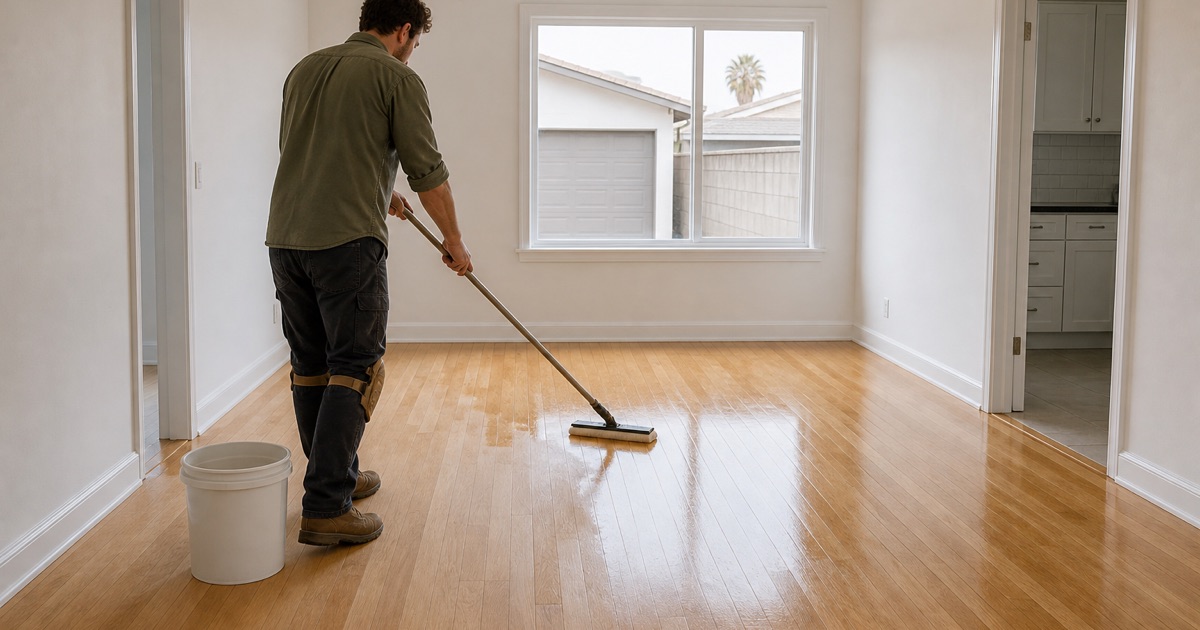
Recoating Rather Than Sanding
The whole economic case for a wood floor in a rental rests on recoating. A floor abraded and recoated before the finish wears through to the wood is renewed for a fraction of the cost of a sand, takes a fraction of the time, and spends none of its remaining thickness. Around 39.2% of the housing units here predate 1950, so a good deal of it is original material with a limited number of sandings left. On those floors recoating is not merely economical, it is what determines whether the floor survives the next few decades at all.
Sheen and What It Hides
Satin and matte finishes conceal dust, scratches and the ordinary marks of daily life far better than higher gloss does. In a rental, where nobody is polishing anything, that difference is the gap between a floor that looks acceptable between tenancies and one that looks neglected. It is one of the few specification decisions that costs nothing and pays every year. We raise it as a matter of course, and it surprises owners how much of the perceived condition of a floor is really about how much light it throws back.
Making the Floor Last Between Tenancies
A Recoat Interval, Written Down
We set a realistic interval at handover based on the product that went down and the traffic the unit takes, and we put it in writing. An owner running several units benefits enormously from having those dates on a schedule rather than reacting when a floor already looks bad. A floor recoated on schedule effectively never needs sanding. A floor recoated when somebody notices it needs it has usually already worn through in the traffic lane, which is exactly the condition a recoat cannot fix.
Repair at Turnover, Not Replacement
Most damage found at a turnover is localized: a stained patch by a window, boards damaged under an appliance, one bad area in an otherwise sound floor. Replacing those boards and recoating the room costs a fraction of a new floor and keeps material that is generally better than its replacement. Turnover is also the only moment the unit is empty, which makes it the cheapest possible time to do the work. A repair deferred to the next vacancy is a repair done in a floor that has had another two years of somebody living on the damage.
Condition Records That Settle Arguments
Photographs and a written note of floor condition at move-in and move-out resolve almost every dispute about damage before it becomes one. We supply that record with any turnover work, because it costs nothing at the time and is impossible to reconstruct afterwards. It also tells the owner something useful over several tenancies: which units wear fastest, which damage keeps recurring, and whether the specification is actually holding up. That is worth more than any single deposit dispute.
Wood Against the Alternatives in a Rental
Why Wood Still Makes Sense Here
The argument for a wood floor in a rental is that it can be renewed rather than replaced. A worn wood floor is sanded or recoated and is then a new floor again; most alternatives, once worn, can only be torn out and thrown away. Over the twenty or thirty years an owner may hold a building, that difference compounds heavily.
It also means the floor holds value rather than depreciating to nothing. An original hardwood floor kept in good order is an asset of the building in a way that a replaceable surface simply is not, and it shows in what the property commands.
Solid Against Engineered
On the raised wood subfloors common in this city, solid flooring can be nailed down and refinished many times, which suits a building somebody intends to keep. Engineered is the better answer over concrete and in units with wide humidity swings, and the wear layer then decides how many refinishes it has in it. The subfloor usually settles the question before preference enters into it. Where both are genuinely available, we set out the cost across the expected holding period rather than the cost on the day, because those two numbers frequently point in opposite directions.
Repairing What Is Already There
A great many buildings here already have original hardwood under carpet or under a later covering, and the cheapest good floor available is very often the one already in the building. Uncovering, repairing and refinishing it usually costs less than any new floor and produces better material than could be bought at the price. Before quoting anything new we check what is underneath. Installing a new floor over a serviceable original one wastes both the old material and the owner’s money, and it forecloses an option that cannot be recovered later.
What that check costs is a few minutes with a corner of carpet lifted in a closet. What it can save is the entire cost of a new floor, on a building where the existing one only needed a recoat and somebody had assumed otherwise. It is also the check most often skipped, because it is nobody’s interest to raise it except the owner’s. A contractor quoting a new floor has no reason to look underneath, and an owner who has not been told there might be something there does not think to ask.
So we raise it as a matter of routine on any building of this age, whatever we were called out to quote for. Around 39.2% of the housing units here predate 1950, which makes an original floor under a later covering a live possibility in a large share of these buildings rather than a remote one.
- Licensed & Insured
- Free Estimates
- 20+ Years Experience








